
How to Use a Goal Setting Journal to Actually Achieve Your Goals Like a Pro
There’s no magic shortcut, just a journal that nudges you toward actually doing the things you say you’ll do. A goal setting journal isn’t about pretty pages and good intentions — it’s the quiet, consistent tool that helps you show up every day. Ready to turn your big ideas into small, repeatable wins? Let’s dive in.
Why A Journal Beats A Brain Dump Any Day
You’ve got dreams, awesome. You also have a brain that forgets snacks, let alone tasks. A goal setting journal turns abstract ambitions into concrete steps you can track. It makes progress visible, which basically is the adult version of clapping for yourself in the mirror.
– You map out what matters most.
– You break it into doable chunks.
– You hold yourself accountable without needing a calendar that stresses you out.
If you’ve tried “thinking about it,” you know that thoughts vanish faster than your coffee going cold on a busy morning.
A journal captures those thoughts before they slip away, then guides you toward action.
Start With The Right Goal, Then Turn It Into A Plan

The secret sauce isn’t just having goals; it’s turning them into plans you can actually execute. Start with clarity, then layer in specifics.
- Declare the outcome you want (the end state).
- Describe the metric that proves you got there (the number, the habit, the milestone).
- Set a reasonable deadline that doesn’t panic you.
Question to chew on: If you achieved this by next month, what would have changed in your life? Write that down in plain language.
From Big Picture To Daily Actions
Break it down into weekly themes and daily tasks. If your goal is “get fit,” your daily task might be “three 20-minute walks” or “30 minutes of yoga,” not “build muscle.” Small wins give you momentum and keep you sane.
Make It Personal (And Honest)
Your journal should feel like a conversation with a friend who tells you the truth. If your plan is too ambitious or too boring, you’ll ditch it. Write in a voice you’d use with a buddy, not a business consultant.
Habit Stacking: The Secret Sauce
Habits compound. Pair a new action with something you already do reliably.
- Attach a new task to a current routine (e.g., “after coffee, log today’s top 1 task”).
- Keep it tiny at first (one small win per day).
- Increase gradually as the habit sticks.
Pro tip: Use a ritual that’s actually enjoyable. If journaling feels like a chore, you won’t stick with it. Maybe pour tea, put on a favorite playlist, or doodle a tiny victory graphic.

Tracking And Accountability Without The Guilt Trip

A journal should support you, not shame you. Track progress in a way that feels empowering, not punitive.
– Use a simple checkbox system: task, done or moved, or canceled.
– Note blockers briefly so you can adjust the plan instead of beating yourself up.
– Celebrate micro-wins. A tiny pat on the back is still progress.
Weekly Review: Don’t Skip This
Set aside 10–15 minutes to review what you’ve done, what you didn’t, and why. This isn’t punishment; it’s a strategic pause. Adjust next week’s tasks based on what happened this week.
Templates That Actually Work (So You Don’t Have To Reinvent The Wheel)
Your journal doesn’t need to resemble a complex manual. A few simple templates do the heavy lifting.
- Outcome, Metric, Deadline – the core trio that keeps goals concrete.
- Weekly Theme – pick one focus area per week (e.g., “communication week”).
- Daily Action – one to three tasks that move you forward.
To-Do List Or Outcome List?
If your brain feels messy, start with daily actions: “Today I will send the cold email.” If you’re more outcome-driven, list the milestone you’re inching toward, then plan tasks to reach it.
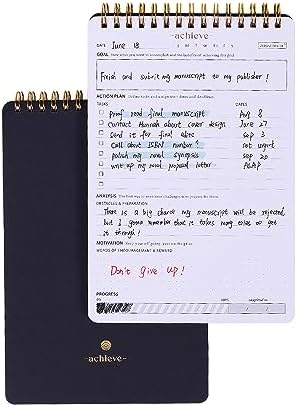
- GOAL PLANNING NOTEPAD – The Goal setting notebook features a highly effective template that will help you to set clear g…
- AMPLE SHEETS & CONVENIENT SIZE – With 54 sheets, the notepad offers plenty of space for goal planning and brainstorming….
- SPIRAL BOUND & SPECIALTY COVERS – Spiral binding ensures a free and comfortable writing experience that allows users to …
Dealing With Slumps Without Abandoning Ship

Everyone has off days. Here’s how to handle slumps without quitting.
- Redefine “failure” as feedback. What didn’t work and why?
- Trim the hill: shorten tasks, extend deadlines, or swap a hard task for an easier one.
- Lean on accountability buddies. Share a weekly win to keep your motivation buoyant.
When Life Throws A Curveball
If life gets busy, your journal can adapt. Move a high-effort task to a later day and temporarily shift your weekly theme. Flexibility beats rigidity when momentum matters.
Using Micro-Milestones For Big Impact
Big goals are intimidating. Break them into micro-milestones that feel plausible.
- Define the smallest possible win that still counts as progress.
- Celebrate that win, then add another micro-step.
- Document the cumulative effect of all micro-wins over time.
Reality check: Micro-wins accumulate into real, meaningful change. They’re like pennies turning into a purpose-full paycheck.
Common Pitfalls And How To Avoid Them
– Overloading the plan: Too many tasks kill momentum. Start small and scale up.
– Vague outcomes: “Be healthier” never ends. Use concrete numbers and deadlines.
– Perfectionism: Waiting for the perfect plan freezes action. Start with “good enough” and adjust.
How To Stay Consistent When Motivation Dips
If motivation dips, lean on habit. You don’t need to feel excited to take the first small step; you just do it. The momentum often follows.
FAQ
How often should I review my goals in the journal?
Review at least weekly. A quick 10–15 minute session helps you adjust tactics, celebrate wins, and reset blockers. If you miss a week, don’t sweat it—just pick up where you left off.
What if I’m not sure what my real goals are?
Start with hygiene goals—things you want less of (stress, clutter) and more of (focus, calm). Then test-and-iterate. Your journal is a sandbox; you can rewrite the sandbox rules as you figure out what truly matters.
Is it okay to revise goals mid-journey?
Absolutely. Goals aren’t carved in stone; they’re living plans. If your priorities shift, update the journal to reflect new outcomes and timelines.
What’s the best way to handle procrastination in a journal?
Break tasks into tiny chunks. If a task feels paralyzing, pick the smallest possible step you can take right now. Even a 2-minute action is progress.
Can I use a digital journal or does a paper journal work better?
Both work. Digital tools are great for reminders and easy editing. Paper journaling helps you slow down and reflect. Pick what you’ll actually use consistently.
Should I share my goals with others?
Sharing can boost accountability, but only if you choose confidants who are supportive and constructive. You don’t need to broadcast everything—just enough to keep you honest.
Conclusion
A goal setting journal is a quiet, consistent tool, not a fancy trophy. It turns your dreams into a sequence of doable steps, tracks your progress, and helps you course-correct without drama. Keep things simple, celebrate small wins, and stay curious about what actually works for you. The more honest you are with your entries, the faster you’ll turn intentions into real, tangible results. Now, grab a pen, pick a seed goal, and start showing up for yourself. Your future self will thank you.